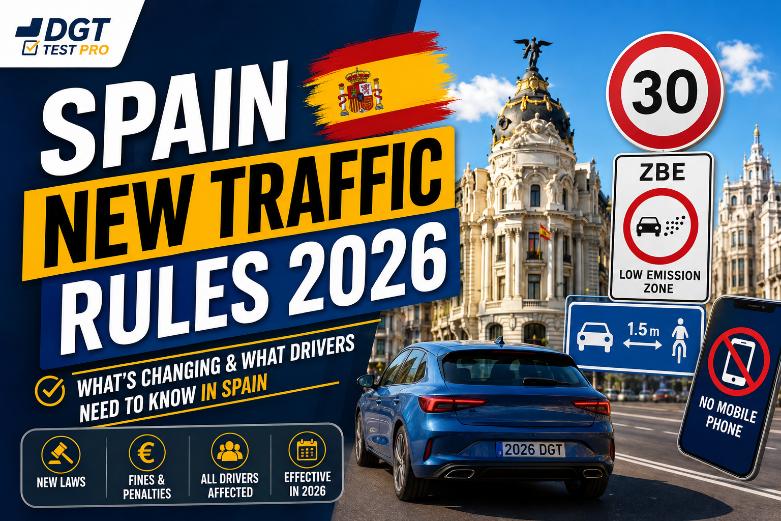
Spain's New Traffic Rules from 1 October 2026 (in English)
Spain's new traffic rules under RD 518/2026 take effect on 1 October 2026. What changes for drivers, cyclists and e-scooter riders, and the exact figures.
Last updated: August 2026. On 1 October 2026, Spain changes several of its road rules. The reform, Real Decreto 518/2026, was published in the official gazette (BOE) on 26 June 2026 and updates the General Traffic Regulations to protect vulnerable road users: pedestrians, cyclists, motorcyclists and riders of personal mobility vehicles (VMP, the e-scooters you see in every Spanish town). If you drive, cycle or ride in Spain, some of these changes affect you directly, and a few carry a one-year transition to 1 October 2027. This guide sets out exactly what changes, the numbers behind why it was passed, and what it means for foreign residents.
Key takeaways
01. Overtaking a cyclist gets stricter. On interurban roads you must drop at least 20 km/h below the limit, leave at least 1.5 m, and change lane fully where there is more than one lane in your direction.
02. A 5 m gap behind cyclists in town. In urban areas, motor vehicles must keep a minimum 5 m distance behind a cyclist in the same lane.
03. Gloves for motorcyclists on the open road. Protective gloves become mandatory for riders and passengers of motorcycles and mopeds on interurban roads.
04. E-scooters get national rules. A minimum age of 15, no pavements, no motorways, no interurban roads, plus always-on lights from 1 October 2027.
05. It is a safety response. Spain's road deaths have plateaued near 1,800 a year, and vulnerable users make up around 40% of interurban deaths, the pressure behind the reform.
What changes, at a glance
The table below is the short version, with the exact figures and the road type each rule applies to. Everything here is taken from the decree text itself, so the confidence is high; the only items with a later date are the two that carry a transition period to October 2027.
| Change | What it requires | Where | From | Source |
|---|---|---|---|---|
| Overtaking cyclists | Reduce speed by at least 20 km/h below the limit, leave at least 1.5 m, change lane fully on multi-lane roads | Interurban | 1 Oct 2026 | Official (BOE) |
| Following a cyclist | Keep at least 5 m behind a cyclist in the same lane | Urban | 1 Oct 2026 | Official (BOE) |
| Motorcyclist gloves | Protective gloves mandatory for rider and passenger | Interurban | 1 Oct 2026 | Official (BOE) |
| Cyclist helmets | Mandatory for all cyclists interurban, and for under-16s on all roads | Interurban + under-16 all roads | 1 Oct 2026 | Official (BOE) |
| E-scooter (VMP) minimum age | You must be at least 15 to ride one | All roads | 1 Oct 2026 | Official (BOE) |
| E-scooter banned areas | No pavements, no motorways or dual carriageways, no interurban roads or travesias | As listed | 1 Oct 2026 | Official (BOE) |
| E-scooter lights | Always-on lighting required (transition period) | All roads | 1 Oct 2027 | Official (BOE) |
Source: Real Decreto 518/2026, de 24 de junio (BOE, 26 June 2026), amending the General Traffic Regulations. Figures quoted are from the decree text. Municipal detail (for example specific urban speed streets) is set by local ordinances.
The timeline: two dates that matter
Jun 26 June 2026: published. Real Decreto 518/2026 appears in the BOE. This is the legal text, but the rules are not yet in force.
Oct 1 October 2026: in force. The main rules take effect: cyclist overtaking, the 5 m urban gap, motorcyclist gloves, cyclist helmets interurban, the e-scooter age and banned areas.
Oct
27 1 October 2027: transition items. Always-on e-scooter lighting and the tighter moped-helmet approval standard become compulsory after a one-year grace period.
Why the reform: the road-safety numbers
Spain has one of Europe's better road-safety records, but progress has stalled. After decades of steep falls, annual road deaths have flattened out near 1,800, and the groups this decree targets, the people outside a car's metal shell, are not improving in step. That is the case the government makes for the change.
Total road deaths in Spain (urban and interurban, deaths within 30 days).
Look inside the total and you see why the reform targets bikes, motorbikes and scooters rather than cars. The chart below uses the DGT's most recent like-for-like figures, the provisional interurban-road balance, to compare 2024 and 2025 by road user. Cyclist deaths fell, but motorcyclist deaths held flat at the highest level of any vulnerable group, and moped and e-scooter deaths ticked up.
Deaths on interurban roads by road user, 2024 vs 2025 (provisional).
A note on the two figures. The DGT publishes two death counts that are easy to confuse. The first chart uses the consolidated annual total (urban plus interurban, counted at 30 days), which is the headline number. The second uses the provisional interurban-only balance the DGT releases each January, which is why its numbers are smaller. We have kept the two apart on purpose, and each chart is labelled with its base.
The changes explained
Overtaking cyclists
This is the change most drivers will notice. On interurban roads, when you overtake a cyclist you must reduce your speed by at least 20 km/h below the road's limit, leave a lateral gap of at least 1.5 m, and pull out into the next lane. Where the road has more than one lane in your direction, a full lane change is now compulsory rather than a partial swerve. A group of cyclists is treated as a single unit, so you overtake the whole group as one, not one rider at a time. In practice, on a road limited to 90 km/h you should be passing at 70 km/h or less, well clear of the rider.
The 5 m gap in town
In urban areas, if a cyclist is riding in your lane and you are behind them, you must keep at least 5 m between your vehicle and the bike. It formalises the tailgating problem cyclists face in city traffic and gives a concrete distance rather than a vague "keep your distance".
Gloves and helmets for two wheels
Riders and passengers on motorcycles and mopeds must wear protective gloves on interurban roads. Proper footwear is expected on all roads. For cyclists, a helmet becomes mandatory for everyone on interurban roads, closing the previous exemptions, and helmets remain compulsory for under-16s on every type of road. Professional cyclists must also wear one in urban zones and travesias while working. The exact technical standard for moped helmets tightens after a transition, taking full effect on 1 October 2027.
E-scooters and personal mobility vehicles
Personal mobility vehicles, the electric scooters now everywhere in Spanish cities, get a national rulebook for the first time under a new urban-circulation title. You must be at least 15 years old to ride one. They are banned from pavements, and banned from motorways, dual carriageways, interurban roads and travesias: they belong on the roadway or bike lanes where local rules allow. Always-on lighting becomes compulsory after a one-year transition, from 1 October 2027. Cities keep the power to add their own detailed rules on top through local ordinances, so the exact streets and speeds can vary by town.
What this means for you
If you drive, cycle or ride in Spain as a foreigner, here is the practical version.
- Give cyclists a full lane and drop your speed. The 20 km/h and 1.5 m rules are enforceable from 1 October. On a two-lane-each-way road, change lane completely to pass. This is stricter than in some home countries, so build the habit now.
- Mind the 5 m gap in town. In city traffic, do not sit on a cyclist's back wheel. Leave the 5 m and wait for a safe, full-lane overtake.
- If you ride, kit up before the open road. Gloves are now required on interurban roads for motorcycles and mopeds, and a helmet is required for all cyclists there. A hire scooter or moped counts too.
- Scooter riders, check your town. No pavements, no interurban roads, minimum age 15, and lights coming in 2027. Local ordinances add detail, so check your city's rules, especially in tourist areas that restrict scooters.
- It can show up in the theory exam. New rules feed into the DGT question bank over time. If you are studying for the licence, you can see the current question format in a free sample test in English.
Frequently asked questions
When do Spain's new traffic rules take effect?
The core rules in Real Decreto 518/2026 apply from 1 October 2026. Two items, always-on e-scooter lighting and the tighter moped-helmet standard, have a transition period and become compulsory on 1 October 2027.
How much space do I have to leave when overtaking a cyclist?
On interurban roads you must leave at least 1.5 m of lateral clearance and reduce your speed by at least 20 km/h below the posted limit. Where there is more than one lane in your direction, you must change lane completely.
Do motorcyclists have to wear gloves now?
Yes. From 1 October 2026, protective gloves are mandatory for riders and passengers of motorcycles and mopeds on interurban roads. Suitable footwear is expected on all roads.
What are the new rules for electric scooters in Spain?
You must be at least 15 to ride a personal mobility vehicle. They are banned from pavements, motorways, dual carriageways, interurban roads and travesias, and must use the roadway or bike lanes where permitted. Always-on lighting is required from 1 October 2027. Your city can add further rules through local ordinances.
Does the reform introduce new fines?
The decree updates the traffic rules themselves. Penalties for breaking them come from Spain's traffic law rather than from this decree, so we do not attach specific fine amounts to these changes here. Check the current penalty for a given offence with the DGT.
Sources
- Real Decreto 518/2026, de 24 de junio, amending the General Traffic Regulations: BOE-A-2026-13889 (published 26 June 2026; in force 1 October 2026).
- DGT, provisional interurban-road death balance for 2025: 1,119 deaths (January 2026).
- DGT, consolidated annual road-death totals: 1,806 deaths in 2023 (with 2022 comparison), and the DGT 2024 annual report (1,785 deaths).
- Vulnerable-user share of interurban deaths: DGTTestPro analysis of the DGT 2025 interurban balance.
Last updated: August 2026.
About DGTTestPro
- Question bank
- 3857+ questions, every one in English and Spanish
- Licence categories
- 7 covered (B, A2, AM, C, D, CAP, B+E)
- Theory book
- 17 chapters, free to read
- Exam simulation
- 30 questions in 30 minutes, pass mark 27/30 - the real DGT format
- Price
- Free to start. Premium is € 24,99 once for 180 days - not a subscription, no auto-renewal.
Questions are written and checked by people against the official DGT syllabus - never AI-generated. Your data stays in the EU.
See what Premium includes · Compare with other DGT test sites
Ready to pass the DGT theory test?
Practise official-format questions in English and Spanish, with explanations after every answer.
Try a free practice test