Spain Speeding Fines 2026: Costs and Penalty Points
Last reviewed 16 October 2026
Speeding fines in Spain 2026: the DGT table (€100 to €600, 0 to 6 points), the camera margin, the 50% discount, Ibiza and Baleares, and when it is a crime.
Quick answer: speeding fines in Spain range from 100 to 600 euros and cost you 0 to 6 penalty points, depending on how far over the limit you were and the limit itself. Pay within 20 days and the fine is cut by 50%. Go far enough over and speeding stops being a fine and becomes a criminal offence. The amounts are fixed by national law, so they are the same in Ibiza, Madrid or Málaga; what changes from place to place is who enforces them and where the cameras are.
The rules behind all of this sit in the Speed chapter of the DGT syllabus, and the theory test asks about them directly.
The DGT speeding fine table (2026)
What you pay depends on two things: how much you exceeded the limit and what the limit was. The law (Annex IV of the Ley de Tráfico) sets the bands per speed limit, but they follow a pattern: urban limits of 30 to 50 km/h are judged on tighter bands than interurban limits of 60 to 120 km/h.
Interurban roads (limits 60 to 120 km/h)
| Km/h over the limit | Fine | Points |
|---|---|---|
| Up to 30 | 100 euros | 0 |
| 31 to 50 | 300 euros | 2 |
| 51 to 60 | 400 euros | 4 |
| 61 to 70 | 500 euros | 6 |
| More than 70 | 600 euros + possible licence suspension | 6 |
Example: on a 120 km/h motorway, 121 to 150 km/h costs 100 euros (0 points); 181 to 190 km/h costs 500 euros and 6 points.
Urban roads (limits 30 to 50 km/h)
| Km/h over the limit | Fine | Points |
|---|---|---|
| Up to 20 | 100 euros | 0 |
| 21 to 30 | 300 euros | 2 |
| 31 to 40 | 400 euros | 4 |
| 41 to 50 | 500 euros | 6 |
| More than 50 | 600 euros + possible licence suspension | 6 |
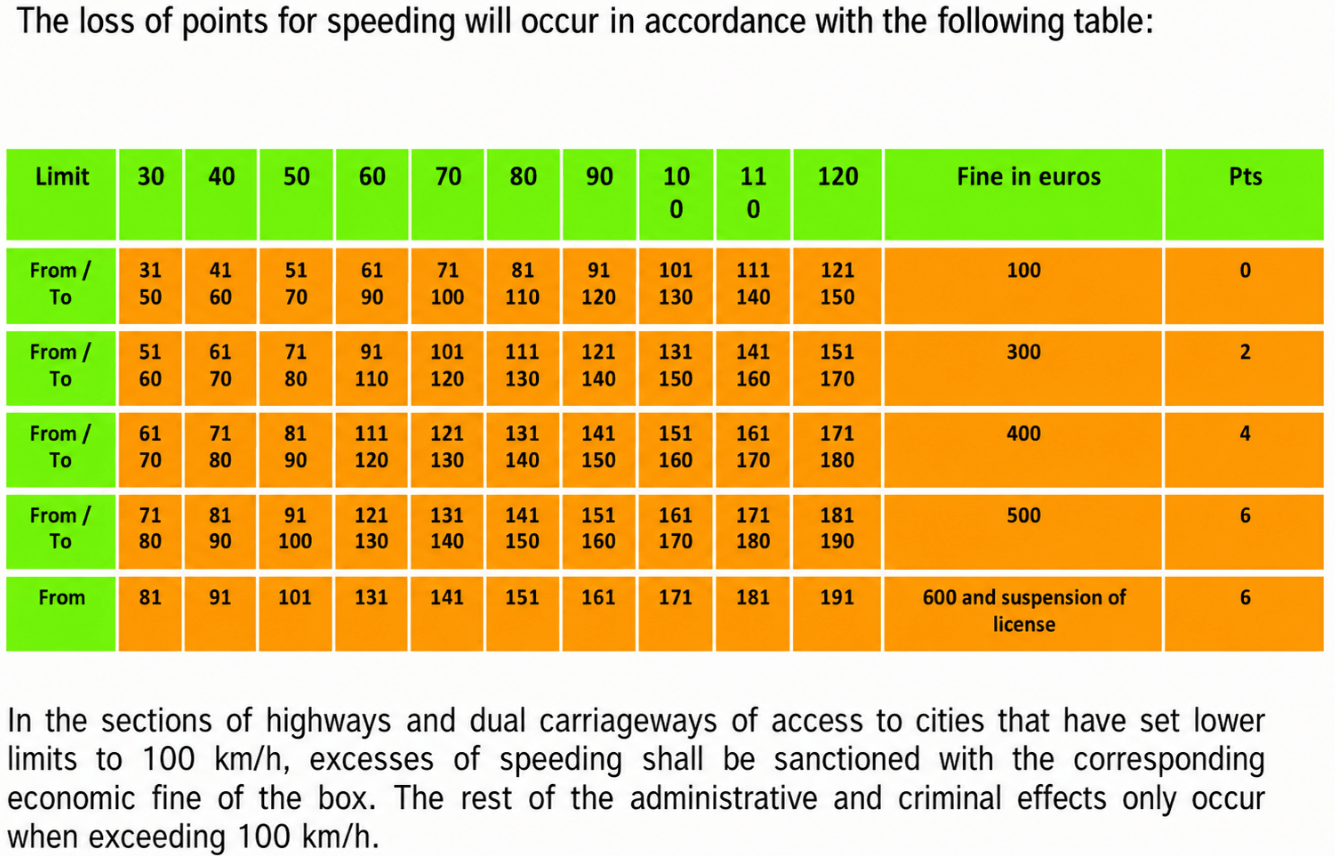
The same table, by speed limit
Because the bands are written per limit, it is easier to read them as "the speed the camera recorded". These four rows cover the limits most drivers meet: the 30 km/h streets that most Spanish towns now use, the 50 km/h urban default, the 90 km/h conventional road and the 120 km/h motorway.
| Limit | 100 euros, 0 points | 300 euros, 2 points | 400 euros, 4 points | 500 euros, 6 points | 600 euros, 6 points |
|---|---|---|---|---|---|
| 30 km/h | 31 to 50 | 51 to 60 | 61 to 70 | 71 to 80 | 81 or more |
| 50 km/h | 51 to 70 | 71 to 80 | 81 to 90 | 91 to 100 | 101 or more |
| 90 km/h | 91 to 120 | 121 to 140 | 141 to 150 | 151 to 160 | 161 or more |
| 120 km/h | 121 to 150 | 151 to 170 | 171 to 180 | 181 to 190 | 191 or more |
Source: Ley de Tráfico (RDL 6/2015), Annex IV, as amended by Ley 18/2021. The 30, 50 and 90 rows are quoted from the annex; the 120 row follows the same band widths.
How the speed-camera margin works
You are not fined the moment you go 1 km/h over. Spanish speed cameras apply a tolerance before recording an offence: roughly 7 km/h on roads up to 100 km/h and about 7% above 100 km/h for fixed cameras. The fine is based on the corrected speed after the margin, not your raw reading. The margin is a measurement allowance, not a free zone: at 128 km/h on a 120 road you are inside it, at 131 you are not.
When speeding becomes a crime
Exceeding the limit by more than 60 km/h in town or 80 km/h on interurban roads is no longer an administrative fine. It is a criminal offence under Article 379.1 of the Spanish Penal Code, punishable by prison (3 to 6 months), a day-fine or community service, plus a driving ban of one to four years. In practice that means 111 km/h on a 50 km/h street or 201 km/h on a motorway. There is no 50% discount and no early payment: the case goes to a criminal court.
The 50% early-payment discount
Article 94 of the Ley de Tráfico gives a 50% reduction if you pay within 20 calendar days counted from the day after the notification, or on the spot to the officer. A 100 euro fine becomes 50, a 300 euro fine becomes 150. Paying the reduced amount closes the case: you give up the right to file allegations or appeal, and any points are still deducted. The discount applies to administrative fines only, never to criminal speeding.
Not resident in Spain? You pay on the spot
If you cannot prove legal residence in Spain, the officer who stops you fixes the fine provisionally and asks you to pay it there and then, by card or in cash, with the 50% reduction. If you do not pay, the vehicle is immobilised until you do. This is the rule that catches visitors on hire cars and drivers on foreign plates, and it is why a roadside stop in Spain can end with a card machine. If the offence was recorded by a camera rather than a stop, the notice goes to the registered keeper: for a hire car that is the rental company, which pays and then charges you, usually with an administration fee on top.
Speeding fines in Ibiza and the Balearic Islands
People searching for Ibiza speeding tickets usually want to know whether the island has its own tariff. It does not. The Balearic Islands have no devolved traffic powers (only Catalonia, the Basque Country and, in part, Navarre do), so the table above applies exactly as it does on the mainland. What is specific to Ibiza is who fines you, where the cameras are and how strictly the summer is policed.
Who enforces what
- Urban streets in Ibiza town, Sant Antoni, Santa Eulària and Sant Josep are policed by each municipality's Policía Local. Their fines are municipal: you pay the town hall, not the DGT.
- Interurban roads are the Guardia Civil's Agrupación de Tráfico. Fixed cameras on those roads are installed by the DGT through its Balearic provincial office, in agreement with the island council.
- The Consell d'Eivissa owns and maintains the island's main roads and sets their limits and signs, but it does not issue speeding fines.
What is different on the ground
- Ibiza town is a 30 km/h city. Since 17 January 2025 every municipally owned street in Vila is limited to 30 km/h ("Área 30"). On a 30 road the 100 euro band ends at 50 km/h and 61 km/h already costs 400 euros and 4 points.
- Local police radar campaigns are intensive in summer. In one week of August 2026 the Policía Local's mobile radar produced 144 speeding sanction proposals in Ibiza town, 28 of them taxis and hire cars with driver. The town hall says the campaigns will continue.
- A fixed urban camera has operated at Avenida Sant Josep and Carrer Corona in Ibiza town since April 2025.
- The island's busiest DGT camera is on the EI-600 at km 9: 28,502 fines in 2025, the 16th most active camera in Spain, after 39,202 in 2024. Balearic traffic fines brought in about 18.2 million euros in 2025, of which some 4.3 million was speeding.
- In Santa Eulària, 39% of the sanction files opened between August 2025 and May 2026 were for speeding on urban streets and travesías, with peaks in the tourist months.
Where to deal with a fine on the island
DGT and Guardia Civil fines are checked and paid at sede.dgt.gob.es. The island's DGT office (Oficina Local de Tráfico, Carrer Vicente Serra Orvay 43, Ibiza) has worked as a satellite of Palma since 2024 with reduced administrative days and appointment only, so the online office is the practical route. Municipal fines are paid through the relevant town hall.
How to check and pay a fine
Check and pay fines on the DGT electronic office at sede.dgt.gob.es, with a digital certificate, Cl@ve or the miDGT app. Registering for the DEV (Dirección Electrónica Vial) means notifications arrive digitally, so you never miss the 20-day discount window. Notices that reach you by post carry the same 20-day clock from the day after delivery. If you were driving someone else's car, the owner must identify you as the driver within the same period; failing to identify the driver is itself a fine.
Speeding fines in Spain: FAQ
How many points do you lose for speeding in Spain?
Between 0 and 6, depending on the excess: 0 points for a minor excess (100 euro fine), rising to 6 points for the most serious speeding (500 to 600 euros).
Do speed cameras have a margin of error in Spain?
Yes. Fixed cameras generally allow about 7 km/h up to 100 km/h and 7% above 100 km/h before an offence is recorded, so the fine is based on the corrected speed.
Is the 50% discount always available?
It applies to administrative fines paid within 20 calendar days of notification, or on the spot, but not to criminal speeding offences.
How much is a speeding ticket in Ibiza?
The same as anywhere in Spain: 100 to 600 euros and 0 to 6 points under the national table. Ibiza town is a 30 km/h city, so the bands are the tight urban ones, and non-residents are asked to pay on the spot.
Can I be fined for speeding in a hire car?
Yes. A camera notice goes to the rental company as the registered keeper; it pays the fine and charges it to you with its own handling fee. If you are stopped by an officer and cannot prove Spanish residence, you pay there and then.
Understanding fines and penalty points is part of the DGT theory exam. See all dangerous-driving offences and points, read how the points system works, study the speed chapter, or practise speed-limit questions.
Sources
- Ley de Tráfico (RDL 6/2015), articles 6, 7, 76, 77, 80, 87 and 94 and Annex IV: BOE consolidated text; Annex IV bands as published by Iberley.
- Código Penal, article 379.1 (criminal speeding thresholds), summarised by RACE.
- Ley 16/2001 transferring Balearic roads to the island councils: BOE; Consell d'Eivissa road network: conselldeivissa.es.
- Ibiza town "Área 30" from 17 January 2025: La Voz de Ibiza.
- Policía Local mobile radar, 144 sanctions in one week (27 August 2026): Periódico de Ibiza; fixed urban camera at Avenida Sant Josep (April 2025): Periódico de Ibiza.
- EI-600 km 9 camera and Balearic fine revenue, DGT data (23 July 2026): Última Hora.
- Santa Eulària sanction files, August 2025 to May 2026 (3 August 2026): La Voz de Ibiza.
- DGT camera installation on Ibiza roads and Guardia Civil enforcement: Noudiari.
- Oficina Local de Tráfico de Ibiza: administracion.gob.es.
Last updated: September 2026. Fines and points can change; confirm current figures on dgt.es before relying on them.
About DGTTestPro
- Learners
- 270+ registered learners
- Question bank
- 6080+ questions, every one in English and Spanish
- Licence categories
- 8 covered (B, A2, AM, C, D, CAP, B+E)
- Theory book
- 40 chapters, free to read
- Exam simulation
- 30 questions in 30 minutes, pass mark 27/30 - the real DGT format
- Devices
- Web app: works in any browser on iPhone, Android, tablet or computer. Install it to your home screen for one-tap access, with no app store account.
- Price
- Free to start. Premium is € 24,99 for the B licence or € 20,99 for any other licence, once for 180 days - not a subscription, no auto-renewal.
Questions are written and checked by people against the official DGT syllabus - never AI-generated. Your data stays in the EU.
See what Premium includes · Compare with other DGT test sites
Ready to pass the DGT theory test?
Practise official-format questions in English and Spanish, with explanations after every answer.
Try a free practice test