Spanish Prohibition Signs (R Series) Explained
Spanish prohibition signs use the R code in a red circle. The ones that catch DGT candidates out, plus R-307 vs R-308: no stopping against no parking.
Spanish prohibition and restriction signs carry an R code and are almost always a red circle on a white background. They tell you something is forbidden or limited: no entry, no overtaking, a speed cap, or no parking. On the DGT theory test they are one of the most common sign topics, so knowing the R series well is a fast way to pick up marks. This guide walks through each group, explains the ones that trip people up (especially R-103 and R-308), and ends with a table and an FAQ.
What are R signs, and why the red circle?
R signs are the prohibition and restriction family in the official Spanish sign catalogue. The letter R stands for reglamentacion (regulation). The shape is the giveaway: a red circle means a rule you must obey, not just a warning. Compare that with the red triangle of a P (warning) sign, which only alerts you to a hazard ahead.
A red circle with a symbol inside tells you what is banned. A red diagonal line usually means "no" of whatever is shown. Blue circular signs, by contrast, are mandatory instructions (things you must do), not prohibitions. If you want the full picture of every family, start with our Spanish road signs in English guide, and see the triangle signs in Spanish warning signs explained.
Two special R signs are not red circles at all. R-1 (Ceda el paso) is the red-bordered triangle pointing down that means give way, and R-2 (Stop) is the red octagon. Everything else in this guide is the classic red circle.
What do the no-entry and access restriction signs mean?
This group controls which vehicles may enter a road. They range from a total ban to bans on one specific type of vehicle. The most misread sign in the whole R series lives here, so read R-103 slowly.
- R-100 (Circulacion prohibida): closed to all vehicles, in both directions.
- R-101 (Entrada prohibida): no entry. This is the solid white bar on a red circle you see at the wrong end of a one-way street.
- R-102 (Circulacion prohibida a vehiculos de motor): no motor vehicles at all.
- R-103: no entry for motor vehicles except two-wheeled motorcycles without a sidecar. This is the exam trap. It does not ban everything with an engine; a solo motorbike may still pass. Read the exemption carefully.
- R-104 (Entrada prohibida a motocicletas): no motorcycles.
- R-105 (Entrada prohibida a ciclomotores): no mopeds.
- R-106: no goods-transport vehicles.
- R-108: no vehicles carrying dangerous goods.
- R-114 (Entrada prohibida a ciclos): no bicycles.
- R-116 (Entrada prohibida a peatones): no pedestrians.

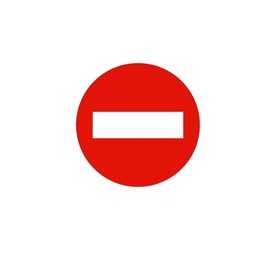
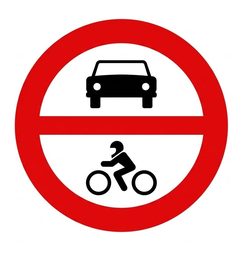
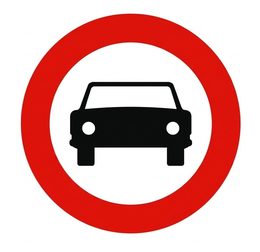
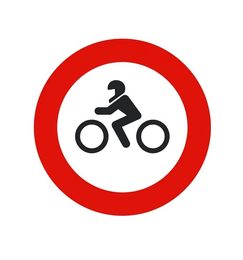
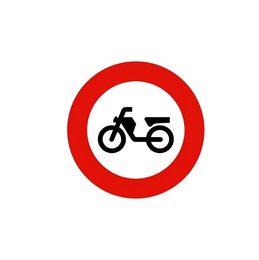
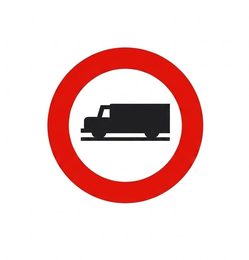
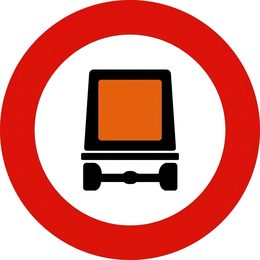
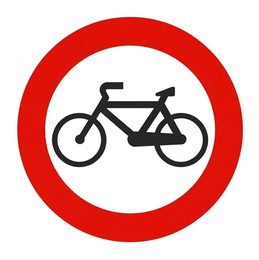
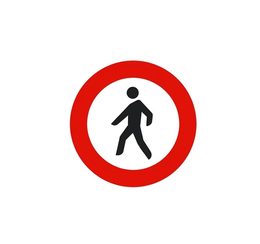
Notice how the symbol inside the circle changes but the message is consistent: whatever is drawn is the thing that cannot enter. R-103 is the exception because it adds an exemption on top.
How do the speed and overtaking signs work?
These are among the most frequently tested R signs, because they change how you drive right away. All three are red circles.
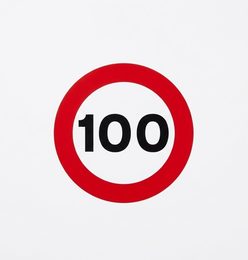
- R-301 (Velocidad maxima): maximum speed limit. The number shown, for example 50 or 90, is the highest speed allowed from that point until it is cancelled.
- R-305 (Adelantamiento prohibido): no overtaking. Shown as two cars side by side, one red. You may not overtake other motor vehicles until the ban ends.
- R-306 (Adelantamiento prohibido para camiones): no overtaking for trucks. The same idea, but it only applies to goods vehicles over a set weight, not to cars.
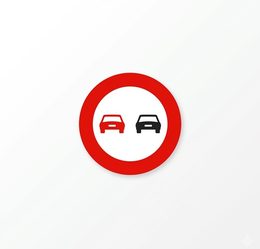
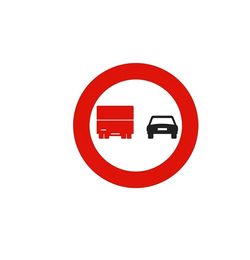
A common mistake is thinking R-305 lasts forever. It does not. The ban ends at the next junction, at an end-of-prohibition sign, or where a specific end-of-no-overtaking sign (R-502) appears. Speed limits work the same way, which we cover in the end-of-restrictions section below.
What do the turning prohibition signs mean?
Turning bans stop you making a particular manoeuvre at a junction. They are red circles with a black arrow crossed out in red.
- R-302 (Giro a la derecha prohibido): no right turn.
- R-303 (Giro a la izquierda prohibido): no left turn. In many cases a no-left-turn sign also implies no U-turn at that point.
- R-304 (Cambio de sentido prohibido): no U-turn. This bans turning around to travel back the way you came.
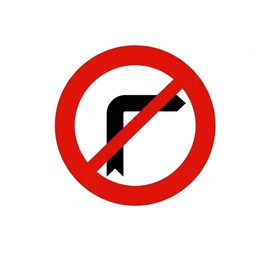
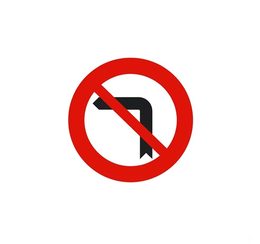
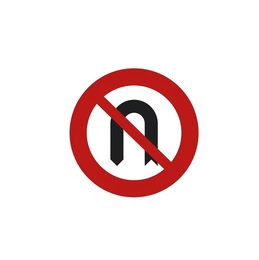
These usually apply at the junction or point where they stand, not for a long stretch of road. Read the arrow direction on the sign carefully, since R-302 and R-303 look almost identical apart from which way the arrow points.
Stopping versus parking: R-307, R-308 and R-309
This is the group English speakers get wrong most often, because "stopping" and "parking" mean different things in Spanish traffic law. Getting the distinction clear is worth easy marks on the DGT test.
R-307: no stopping and no parking
R-307 (Parada y estacionamiento prohibidos) is the stricter one. You may neither park nor even stop. That means no halting to drop someone off, no waiting, nothing. The sign is a red circle crossed by a single red diagonal line on a blue background.
R-308: no parking only
R-308 (Estacionamiento prohibido) is less strict. It bans parking, but a brief stop is still allowed, for example to let a passenger out or to load and unload while you stay with the vehicle. The sign is a red circle with a single red diagonal line, distinct from R-307's two crossed lines.
R-309: limited parking zone
R-309 (Zona de estacionamiento limitado): marks a zone where parking is restricted by time or by conditions, such as a paid or blue-zone area. It does not ban parking outright; it limits it.
In Spanish, parada means a short stop and estacionamiento means parking. R-307 bans both; R-308 bans only the second. If you remember nothing else from this guide, remember that pair.
How do the weight and size limit signs work?
These R signs restrict access based on the physical dimensions or mass of your vehicle. Each shows a number inside the red circle, and you may not pass if your vehicle exceeds it.
- R-201 (Limitacion de masa): no vehicles over the total mass shown, in tonnes.
- R-202 (Limitacion de masa por eje): no vehicles over the mass per axle shown.
- R-203 (Limitacion de longitud): no vehicles longer than the length shown.
- R-204 (Limitacion de anchura): no vehicles wider than the width shown.
- R-205 (Limitacion de altura): no vehicles taller than the height shown. This one matters at low bridges and tunnels.
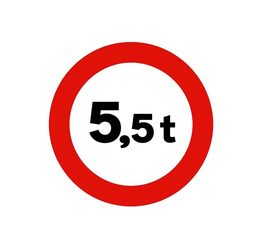
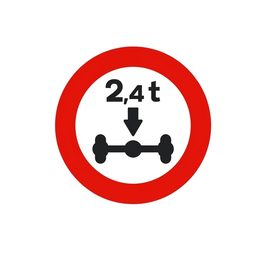
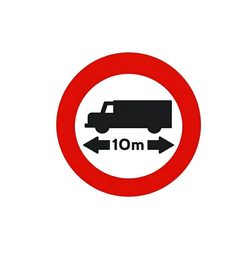
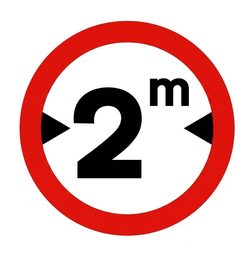
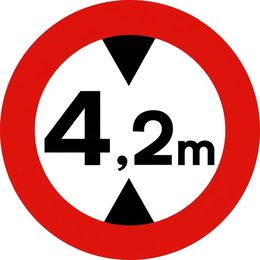
For a standard car these rarely apply, but they appear on the exam, so know that the number is a maximum, not a minimum. If your vehicle is at or under the figure, you may proceed.
What do the end-of-restriction signs mean?
Once a prohibition applies, something has to cancel it. The end-of-restriction signs do that. They are white or grey circles crossed by a diagonal band, which signals that a previous rule no longer applies.
- R-500 (Fin de prohibiciones): end of all prohibitions previously in force. Every restriction shown earlier is lifted.
- R-501 (Fin de limitacion de velocidad): end of the speed limit. The general limit for that type of road now applies again.
- R-502 (Fin de prohibicion de adelantamiento): end of the no-overtaking ban. You may overtake again from this point.
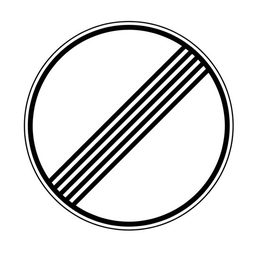
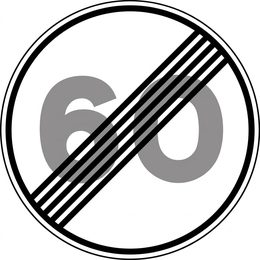
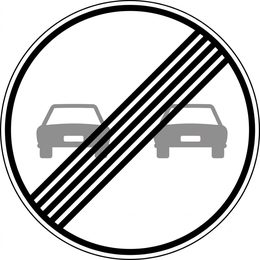
These signs are easy to overlook because they look plain, but they answer a question the exam loves to ask: "until when does the restriction last?" The answer is usually until one of these appears, until the next junction, or until a new sign replaces it.
R series quick-reference table
Here is a compact summary of the R signs covered above. Use it to revise before your test.
| Code | Spanish name | English meaning |
|---|---|---|
| R-100 | Circulacion prohibida | Closed to all vehicles, both directions |
| R-101 | Entrada prohibida | No entry (one direction) |
| R-102 | Circulacion prohibida a vehiculos de motor | No motor vehicles |
| R-103 | Entrada prohibida a vehiculos de motor excepto motociclos de dos ruedas sin sidecar | No entry for motor vehicles except two-wheeled motorcycles without a sidecar |
| R-104 | Entrada prohibida a motocicletas | No motorcycles |
| R-105 | Entrada prohibida a ciclomotores | No mopeds |
| R-106 | Prohibida a vehiculos de mercancias | No goods-transport vehicles |
| R-108 | Prohibida a mercancias peligrosas | No vehicles carrying dangerous goods |
| R-114 | Entrada prohibida a ciclos | No bicycles |
| R-116 | Entrada prohibida a peatones | No pedestrians |
| R-201 | Limitacion de masa | Maximum total weight limit |
| R-202 | Limitacion de masa por eje | Maximum weight per axle |
| R-203 | Limitacion de longitud | Maximum length |
| R-204 | Limitacion de anchura | Maximum width |
| R-205 | Limitacion de altura | Maximum height |
| R-301 | Velocidad maxima | Maximum speed limit (value shown) |
| R-302 | Giro a la derecha prohibido | No right turn |
| R-303 | Giro a la izquierda prohibido | No left turn |
| R-304 | Cambio de sentido prohibido | No U-turn |
| R-305 | Adelantamiento prohibido | No overtaking |
| R-306 | Adelantamiento prohibido para camiones | No overtaking for trucks |
| R-307 | Parada y estacionamiento prohibidos | No stopping and no parking |
| R-308 | Estacionamiento prohibido | No parking (stopping still allowed) |
| R-309 | Zona de estacionamiento limitado | Limited parking zone |
| R-500 | Fin de prohibiciones | End of all prohibitions |
| R-501 | Fin de limitacion de velocidad | End of speed limit |
| R-502 | Fin de prohibicion de adelantamiento | End of no-overtaking |
Frequently asked questions
What does R-308 mean?
R-308 (Estacionamiento prohibido) means no parking. You cannot leave your vehicle parked in the area it covers, but a short stop is still allowed, for example to let a passenger out or to load and unload while you stay with the car.
What does R-103 mean?
R-103 means no entry for motor vehicles, except two-wheeled motorcycles without a sidecar. It is a common exam trap. It does not ban every vehicle with an engine; a solo motorbike may still enter. Always read the exemption before answering.
What is the difference between R-307 and R-308?
R-307 bans both stopping and parking, so you may not even halt briefly. R-308 bans only parking, so a short stop to drop off or load is still allowed. In short: R-307 is stricter, R-308 lets you stop but not park.
Are R signs always a red circle?
Almost always, yes. Prohibition and restriction R signs use a red circle. The two exceptions are R-1 (give way), a downward red triangle, and R-2 (Stop), a red octagon. End-of-restriction signs use a plain circle with a diagonal band.
Does a speed limit sign (R-301) apply forever?
No. An R-301 speed limit applies until it is cancelled by an end-of-limit sign (R-501), a new speed sign, an end-of-all-prohibitions sign (R-500), or a change of road type, such as entering a town.
Sources
- DGT catálogo oficial de señales de tráfico.
Last updated: August 2026.
About DGTTestPro
- Learners
- 270+ registered learners
- Question bank
- 6080+ questions, every one in English and Spanish
- Licence categories
- 8 covered (B, A2, AM, C, D, CAP, B+E)
- Theory book
- 40 chapters, free to read
- Exam simulation
- 30 questions in 30 minutes, pass mark 27/30 - the real DGT format
- Devices
- Web app: works in any browser on iPhone, Android, tablet or computer. Install it to your home screen for one-tap access, with no app store account.
- Price
- Free to start. Premium is € 24,99 for the B licence or € 20,99 for any other licence, once for 180 days - not a subscription, no auto-renewal.
Questions are written and checked by people against the official DGT syllabus - never AI-generated. Your data stays in the EU.
See what Premium includes · Compare with other DGT test sites
Ready to pass the DGT theory test?
Practise official-format questions in English and Spanish, with explanations after every answer.
Try a free practice test