Chapter 9 - Driver Licence
To legally drive in Spain, all drivers must hold a valid licence or permit corresponding to the vehicle they intend to operate. This chapter describes the types of licences, their requirements, duration, renewal, the points-based system, and the documents every vehicle must carry.
9.1 Types of Driving Licences
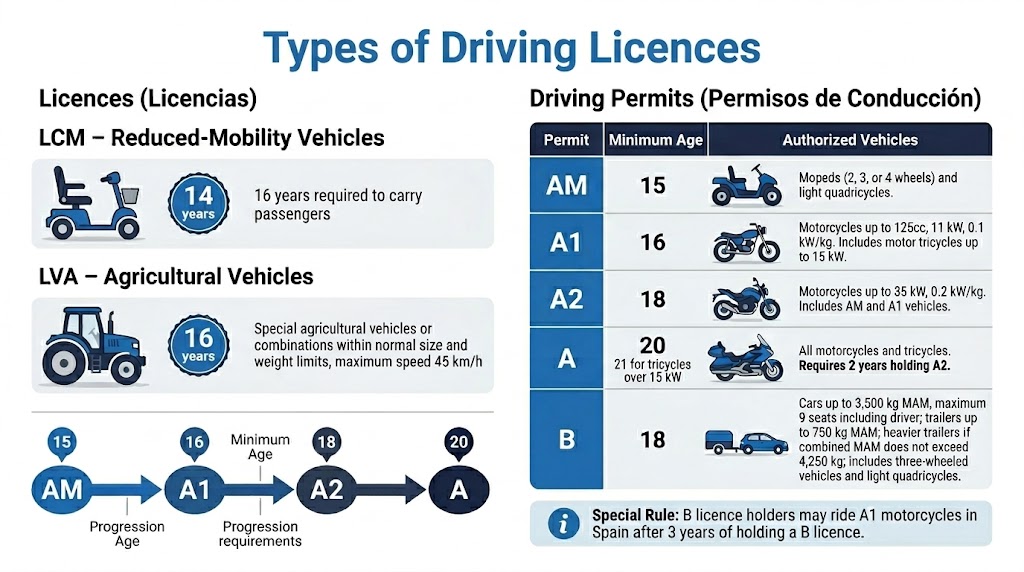
There are two main categories of documents that allow people to drive motor vehicles on public roads.
9.1.1 Licences (Licencias)
9.1.2 Driving Permits (Permisos de conduccion)
Required for most motor vehicles:
| Permit | Min. age | Authorises |
|---|---|---|
| AM | 15 | Mopeds (2, 3, or 4 wheels) and light quadricycles. |
| A1 | 16 | Motorcycles up to 125cc, 11 kW, and 0.1 kW/kg ratio. Includes motor tricycles up to 15 kW. |
| A2 | 18 | Motorcycles up to 35 kW and 0.2 kW/kg. Includes AM and A1 vehicles. |
| A | 20 (21 for tricycles over 15 kW) | All motorcycles and tricycles. Requires 2 years holding A2. |
| B | 18 | Cars up to 3,500 kg MAM with up to 9 seats (incl. driver). Also: light trailers (up to 750 kg MAM); heavier trailers if combined MAM up to 4,250 kg; three-wheeled vehicles and light quadricycles. |
9.2 Novice Drivers
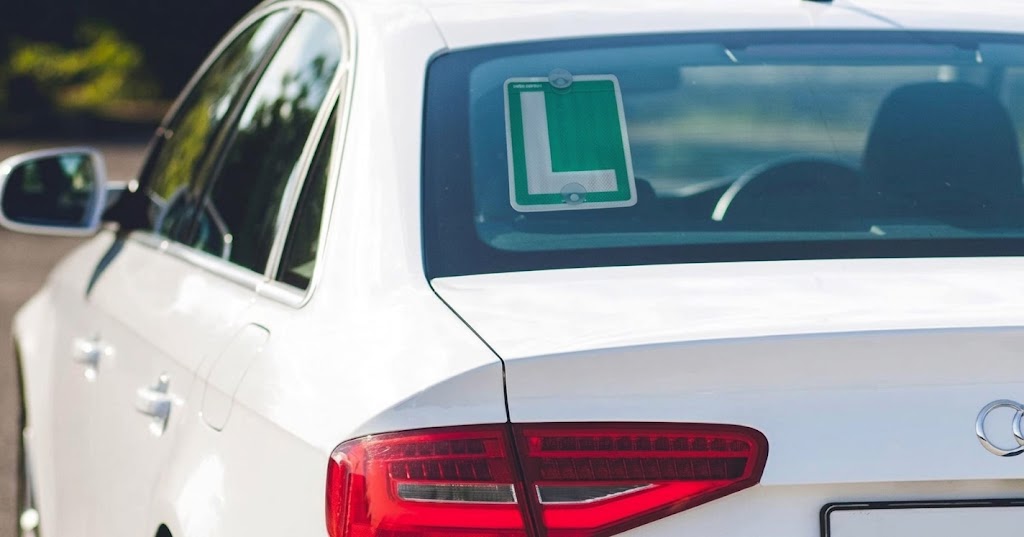
A driver is considered "novel" during the first 12 months after obtaining their first licence. During this period they must display a green rectangular plate with a white letter "L" on the rear window of the car. This marks them as a new driver and warns others.
9.3 Points-Based Licence System
9.3.1 Initial Balance
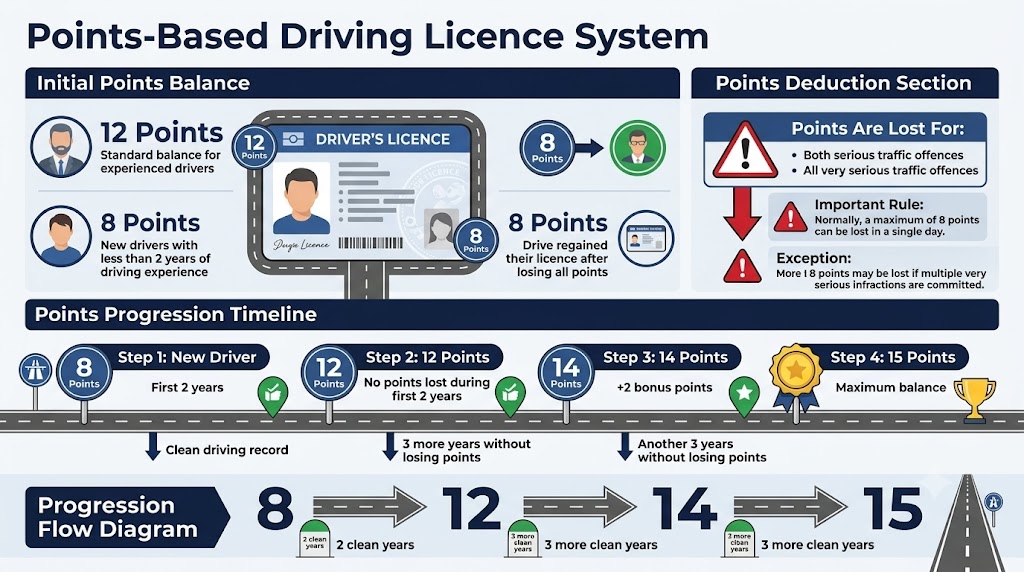
- 12 points: standard balance for experienced drivers.
- 8 points: for drivers with less than 2 years' experience, and drivers who have regained their licence after losing all points.
Points are lost for committing serious or very serious infractions. Generally, no more than 8 points can be lost in a single day, unless very serious infractions are committed.
How the balance grows:
| Milestone | Points |
|---|---|
| New driver - first two years | 8 |
| No points lost in that period | 12 |
| Keep 12 points for a further 3 years (+2) | 14 |
| Keep 14 points for another 3 years (+1) | 15 (maximum) |
9.3.2 Gaining Points
- After 2 years without point-loss, the balance is restored to 12 points (3 years if a very serious infraction was committed).
- After 3 additional years with no infractions, 2 bonus points are awarded.
- After another 3 years, 1 more point is awarded.
- Maximum balance: 15 points.
9.3.3 Losing Points
A driver loses points when committing certain offences while driving.
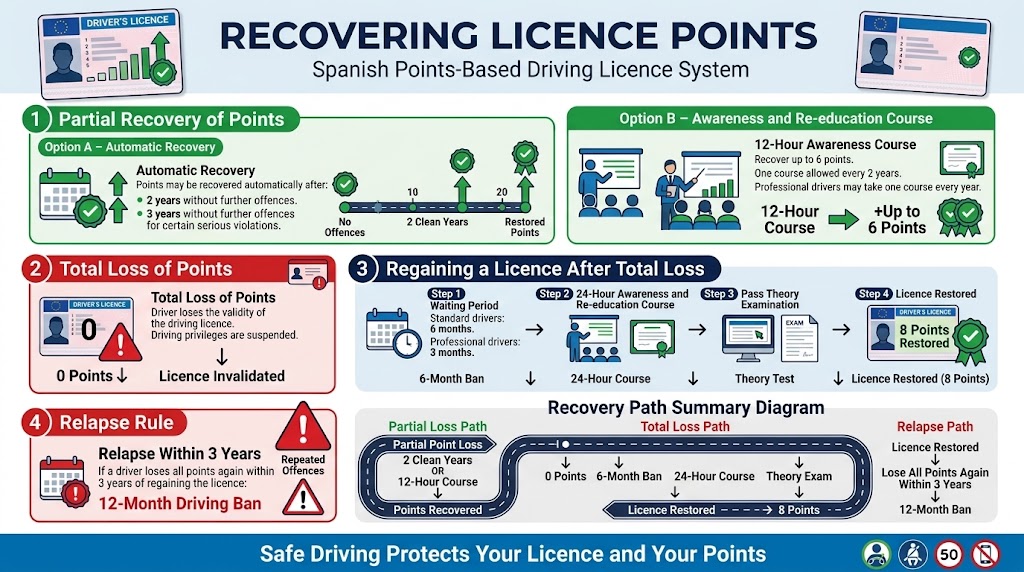
- If a person loses all their points, they cannot drive again for six months.
- After those six months, they must complete a 24-hour course and pass an exam at the Traffic Department to recover their points and licence.
- If they lose all points again within the following three years, they must wait 12 months before recovering them.
- Drivers who lose only some points can get them back if they commit no further offences in the next two years.
- They may also attend a 12-hour road-safety course to recover up to 6 points.
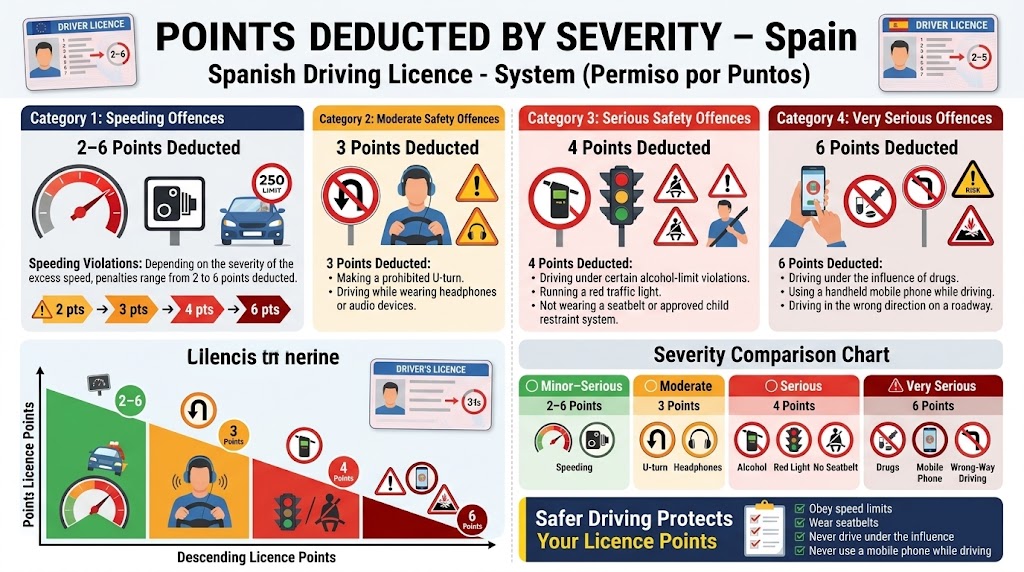
Offences that remove 2-6 points
- Driving above the speed limit. The number of points lost depends on the actual speed in each case.
Offences that remove 3 points
- Making a U-turn where it is not allowed.
- Driving while wearing headphones/earphones connected to a mobile phone or other electronic device.
- Carrying devices designed to detect speed-enforcement radars or cameras.
Offences that remove 4 points
- Driving with a breath alcohol level between 0.25 and 0.50 mg/L of air. (Professional drivers and those licensed under two years: 4 points at 0.15-0.30 mg/L.)
- Driving with a licence that does not authorise that vehicle (e.g., driving a car when licensed only for motorcycles).
- Failing to respect right-of-way for other drivers or pedestrians, and not stopping at STOP signs, Yield signs, or red lights.
- Overtaking where overtaking is prohibited.
- Reversing on motorways or dual carriageways.
- Ignoring or disobeying traffic officers' signals and instructions.
- Not keeping a safe distance from the vehicle in front.
- Driving when the driver has lost their licence due to traffic offences.
- Not wearing a seat belt or helmet, or not using child restraints and other mandatory safety equipment.
Offences that remove 6 points
- Driving with a breath alcohol level above 0.50 mg/L of air. (Professional drivers and those licensed under two years: 6 points above 0.30 mg/L.)
- Driving after taking drugs, or with traces still in the body.
- Refusing to take alcohol or drug tests.
- Driving in the opposite direction to that allowed, taking part in illegal races, or driving in a way that endangers others' lives.
- Driving with devices designed to block speed cameras or radars.
- (Professional drivers) Driving more than half beyond permitted driving time, or taking breaks shorter than the legal minimum - e.g., 6 hours straight when the limit is 4, or a 10-minute break instead of at least 20.
- Fitting devices that alter speed limiters or tachographs (which record a professional driver's driving time).
- Driving while holding a mobile phone in your hand.
- Throwing objects onto the road that could cause fires or accidents.
- Overtaking in a way that endangers cyclists, or without leaving at least 1.5 metres of space.
9.3.4 Recovering Points
9.4 Validity and Renewal
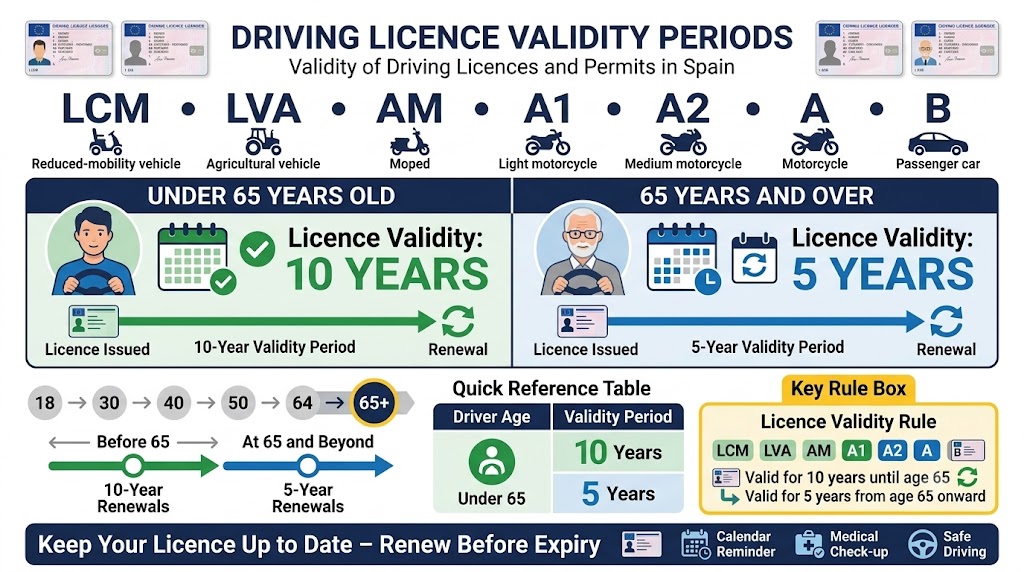
Driving licences and permits (LCM, LVA, AM, A1, A2, A, and B) are valid for:
- 10 years up to age 65.
- 5 years from age 65 onwards.
To renew, the driver must still meet the original eligibility criteria and must not have lost all points. Apply for renewal before the licence expires. You must also apply for a new licence if it is lost, stolen, or if any personal details change.
9.5 Duplicates and Data Changes
Any change in personal information (e.g., address) must be reported to the Provincial Traffic Office within 15 days.
Duplicates must be requested in case of:
- Loss
- Theft
- Damage
9.6 Vehicle Documents
9.6.1 Registration Certificate
Confirms a vehicle is registered and authorised to be driven on public Spanish roads.
Vehicles that must have it: all motor vehicles; mopeds; trailers and semi-trailers with a maximum authorised mass exceeding 750 kg.
Information shown:
- Full name and address of the vehicle owner.
- Vehicle registration number and date of registration.
- Number of seats in the vehicle.
- Purpose of the vehicle (transport of people or goods).
- Maximum authorised load weight.
9.6.2 Technical Inspection Certificate
Proves a vehicle has no faults and is in good condition to operate.
Vehicles that must have it: all motor vehicles; all mopeds; all trailers and semi-trailers.
Information shown: vehicle characteristics, and a record of inspections the vehicle has passed.
When to take your vehicle for inspection (ITV)
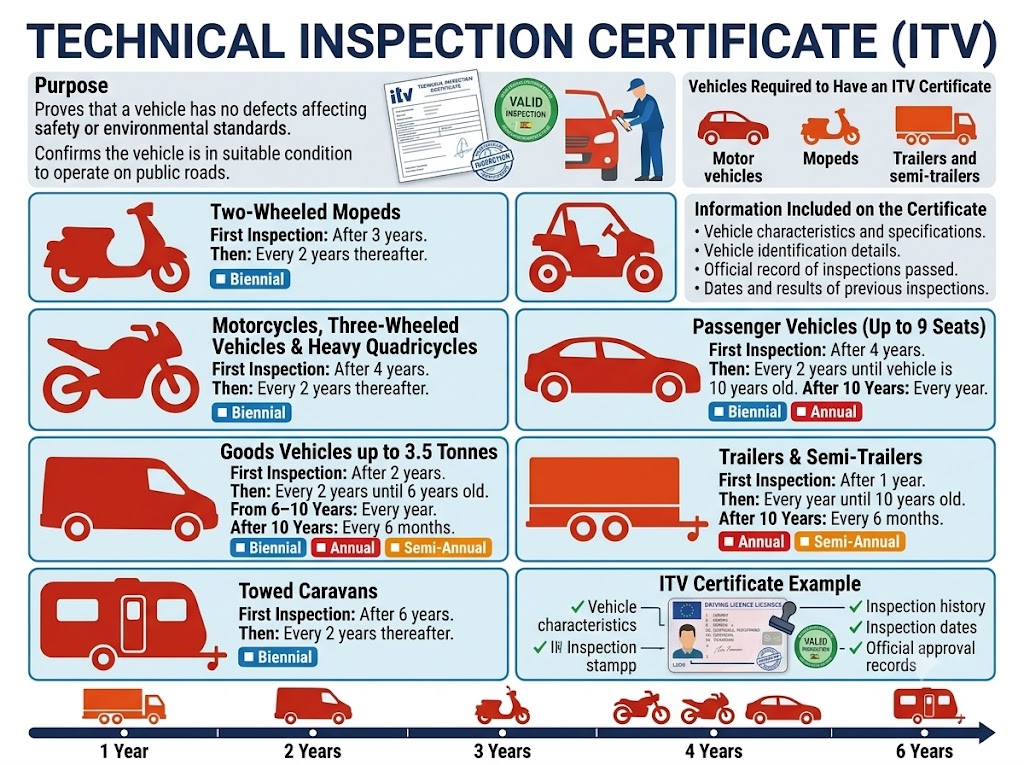
| Vehicle type | First inspection | Subsequent inspections |
|---|---|---|
| Two-wheeled mopeds | After 3 years | Every 2 years thereafter |
| Three-wheeled mopeds and light quadricycles | After 4 years | Every 2 years thereafter |
| Motorcycles, three-wheeled vehicles, and heavy quadricycles (quads) | After 4 years | Every 2 years thereafter |
| Motor vehicles carrying up to nine passengers | After 4 years | Every 2 years until 10 years old; every year after 10 years |
| Motor vehicles carrying goods up to 3.5 tonnes | After 2 years | Every 2 years until 6 years old; every year from 6 to 10 years; every 6 months after 10 years |
| Trailers for goods/people or living accommodation (except towed caravans) | After 1 year | Every year until 10 years old; every 6 months after 10 years |
| Towed caravans | After 6 years | Every 2 years thereafter |
Results of the inspection
If the vehicle is in good condition, the ITV technicians record on the certificate that it has passed and indicate the next inspection date, issue a sticker (placed inside the vehicle, on the right side of the windshield), and provide an inspection report - which you must always keep in the vehicle.
9.6.3 Compulsory Civil Liability Insurance
Owners of motor vehicles must take out and pay for insurance. It protects other people, property, or vehicles in case you cause an accident.
Which vehicles must have it
All motor vehicles owned by a person residing in Spain, except: trains and trams, wheelchairs, and motorised toys. Also exempt: trailers, semi-trailers, and towed machinery with a maximum authorised load not exceeding 750 kg.
What it covers
- Damage caused by your vehicle to property (e.g., repairing a streetlight you crash into).
- Injury or damage caused to another person (e.g., hitting a pedestrian).
It does not cover injuries to another person if their own behaviour caused the incident (e.g., a pedestrian deliberately throwing themselves in front of your car), nor injuries/damage from events unrelated to driving (e.g., an accident caused by a hurricane or fire).
What is not covered
- Injuries suffered by the driver of the insured vehicle (e.g., the driver's own medical expenses).
- Damage to objects inside the driver's vehicle.
- Damage to property belonging to the insured person, the driver, or their relatives (e.g., a garage door damaged while entering a relative's house).
- Injuries to people not wearing a helmet when one is mandatory.
Consequences of not insuring a vehicle
- The vehicle is not allowed to circulate. If stopped by an officer, it will be immobilised immediately.
- The owner must pay the costs of where the vehicle remains parked while uninsured.
- The owner must also pay a fine.
Ready to test your knowledge?
Practice questions covering everything in Chapter 9 - Driving Licence.Última actualización: 2026-06-27
Practica las preguntas de este capítulo
La teoría es gratis. Crea una cuenta gratis para practicar preguntas con formato oficial y seguir tu progreso.